Art & Spirit
The connection between spirituality and art
Spirituality is a complex subject. These exhibitions explore connections between spirituality, faith, and art. They also explore faith in art, both for the viewer and the creator.
1st EDITION
'Art & Spirit' (Femke Hoyng solo) in the Netherlands


2nd EDITION
'Art & Spirit' (Femke Hoyng and 3 other artists) in FRANCE

3rd EDITION
'Art & Spirit' in FRANCE
Galerie46 in Hesdin


Femke Hoyng
6 Expressions of 'Art&Spirit'

Houses of Faith

The Cross

Prehistoric animals

Hindu Gods
vases

Grave wreaths

Animationfilm
Pocomovoso
HOUSES OF FAITH
Houses of faith (churches, synagogues, temples, mosques, etc.) are built with great care. They must be beautiful, attractive, and clearly visible. It resembles an artistic expression:
"Art"
"The ability to create beauty and evoke aesthetic pleasure."
But can you really say that? Do spirituality and religion allow for visual pleasure? Can you call a house of faith an architectural work of art? Must it be beautiful and impressive? Who does it impress? Who should it impress? Is such an impression an artistic experience? Are these buildings art in themselves, do they only become so after Femke Hoyng's processing, or does the image remain merely a record of a building?
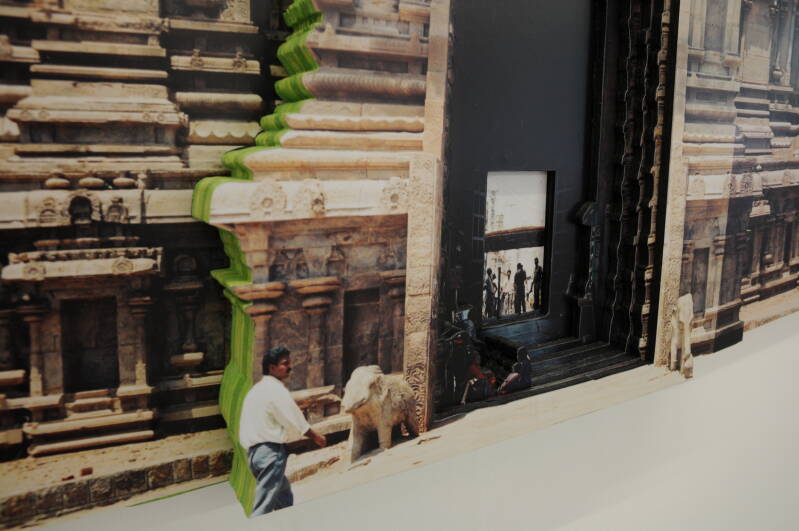
The technique of "Photos in Relief"
Femke Hoyng's work seems somewhat naive and archaic. She creates "Photos in Relief" with great expertise; multidisciplinary combinations of photography, woodworking, and painting. Hoyng literally adds depth to photographs of varying depth. The pieces are cut out and placed on figured wooden panels of varying heights. The photographs themselves are not manipulated; the flat surface is drawn in only one spatial dimension. Hoyng places the relief in a (sometimes articulated) frame on which she paints colorful patterns and symbols that engage with the culture of the country where the photograph was taken. With her "Photos in Relief," Femke Hoyng has developed a unique method for disrupting the stillness of photography. By adding spatiality, a snapshot is set in motion.
Hindu temple in Madurai, India
120 x 120 cm


Mormon church in San Diego, Californie, USA
125 x 125 cm


Mosque in Burkina Faso, Africa
120 x 120 cm


Temple in India
cm x cm


Onion-church in Rusland
cm x cm

Buddhist temple in Kalmukkie (Russia)
cm x cm
Holy Men
cm x cm


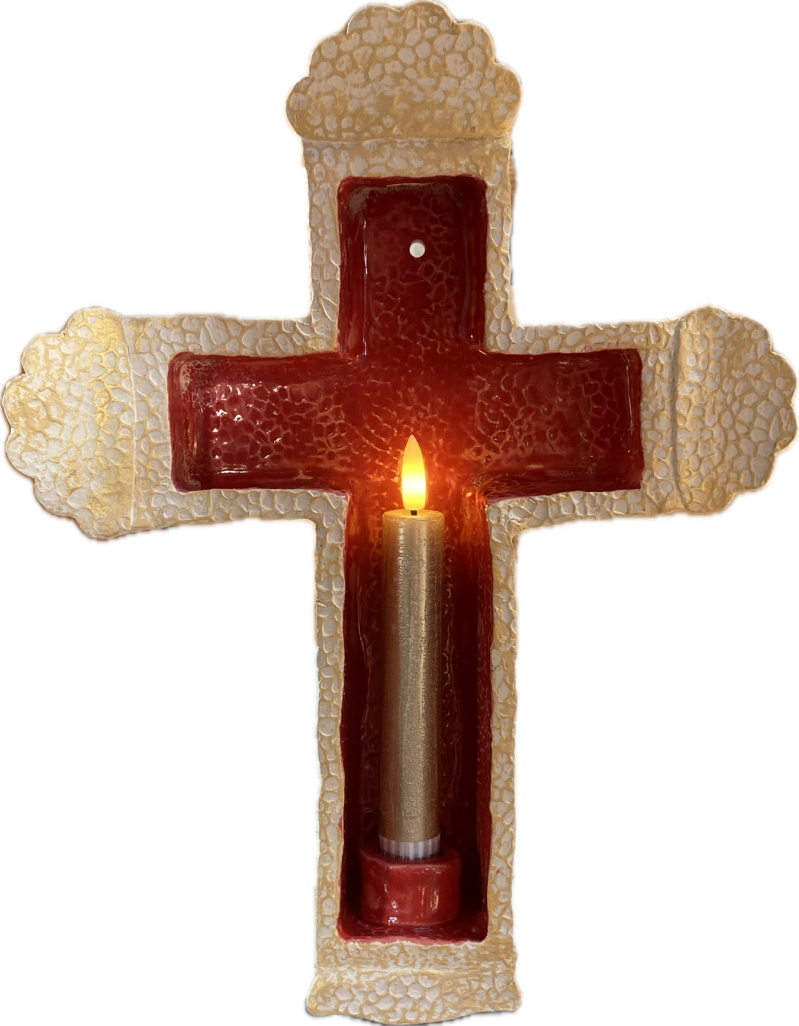
THE CROSS
An incredibly simple shape with so much meaning: two lines intersecting at a specific point.
Their relationship gives this combination a clear meaning understood worldwide: that of a sacred symbol.
Originally, the cross was a symbol of beauty and civilization (in the Neolithic period, 10,000-2,000 BC).



VIDEO Hindu cross

VIDEO Eyes cross

VIDEO Tao cross

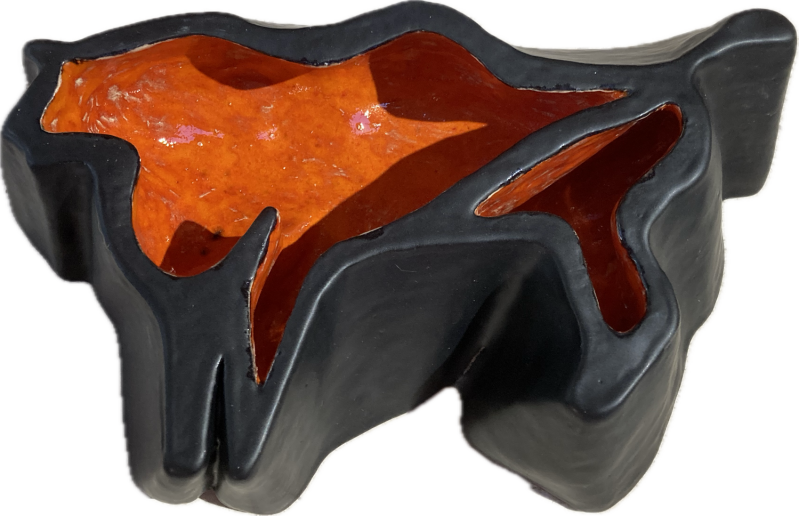
PREHISTORIC ANIMALS
Prehistoric people who created cave paintings are now considered by some to be the first "artists." They were often women. It was a tribute to animals and nature. People expressed gratitude for food, hides that provided warmth, and bones that could be used as weapons, cooking utensils, or jewelry.
At the same time, drawing primitive animals was a ritual to give hunters courage and hope for a good reward, as their work was not without danger. Cave paintings were educational for children: they learned what animals and hunting looked like. And which animals we had to flee from very quickly!
The ritual of drawing primitive animals offered hope, security, and faith.




HINDU GODS VASES
Colorful India, with its imaginative Hindu faith, inspires creativity.
According to Hindus, there are 17,000 gods. All the stories can be read in the Indian epic, the Mahabharata, a kind of Hindu bible.
In the South Indian city of Madurai stands a vast temple complex. It depicts all 17,000 Hindu gods. Below, several of them have been incorporated into ceramic vases.

Mister Mustache

Shiva

Gods with 8 arms

GRAVE WREATH


French 'Couronnes'
In France, these "couronnes" were placed on graves or hung on church walls. They are delicately handcrafted using wire and glass beads, originally made in prisons by female inmates.
Following this ancient French technique, I create grave wreaths featuring images of the deceased. These can be either people or animals.

Animatiefilm 'POCOMOVOSO'

The Swastika, a lucky sign.
The swastika, or hooked cross, is at least four thousand years old. Swastika is Sanskrit for well-being, happiness. A lucky sign, therefore, that occurred in many cultures: in Mesopotamia, ancient Greece and India, the Middle East, Europe, Japan, China, among certain African peoples and among Native Americans (the Maya and the Navajo). The swastika is said to represent the sun moving in the firmament. A solar wheel, a sign of change and light. Among the Germanic peoples, it was a symbol for the thunder god Thor or his hammer, and it was used as a ward against lightning and fire.